Table of Contents
ToggleA kitchen backsplash is one of the highest-impact, most visible upgrades a homeowner can make. Whether someone’s updating a dated kitchen or starting fresh, the right backsplash tile transforms the entire room, and it’s a project most DIYers can tackle themselves. The challenge isn’t the installation: it’s choosing from the seemingly endless options available. From timeless subway tiles to hand-crafted artisan pieces, backsplash choices range from budget-friendly to statement-making. This guide walks through 10 stunning kitchen backsplash tile ideas, covering materials, installation realities, and how each style impacts a kitchen’s look and feel. Whether the goal is understated elegance or bold personality, there’s a tile solution here.
Key Takeaways
- Kitchen backsplash tile ideas range from affordable subway tiles ($1–$3/sq ft) to premium handmade artisan pieces, giving homeowners options for any budget and style preference.
- Substrate preparation is critical for any backsplash installation—a level, flat, and waterproofed wall prevents imperfections from telegraphing through tiles and ensures longevity.
- Grout color, finish selection, and tile material (ceramic, natural stone, glass, or metal) dramatically impact both aesthetics and maintenance requirements in your kitchen.
- Natural stone backsplashes like marble and granite bring luxury and depth but demand regular sealing and careful maintenance to resist staining and etching.
- Patterned and mosaic tiles add visual interest and personality, though they require precise spacing, careful layout planning, and often more installation time than simple grids.
- Metallic and glass tiles deliver modern sophistication and light reflection, making kitchens feel larger and more dynamic, but work best as accents rather than full coverage.
Classic Subway Tile: Timeless Elegance With Modern Versatility
Subway tile remains the most popular backsplash choice for good reason. The 3×6-inch (nominal size: actual dimensions are roughly 2.75 × 5.75 inches) rectangular format is forgiving to install, widely available, and works in virtually any kitchen aesthetic. It originated in New York City subway stations over a century ago and has never fallen out of favor.
The real versatility comes from finish and grout choices. Glazed ceramic subway tile is affordable, typically $1–$3 per square foot, and easy to clean, making it practical for kitchens. Matte finishes feel modern and hide fingerprints better than glossy versions. Grout color matters enormously: white or light gray grout creates a clean, modern grid effect, while dark charcoal or black grout emphasizes the tile lines for architectural interest.
Subway tile also comes in natural stone varieties. Honed marble subway tiles add luxury without overwhelming the eye, though marble requires sealing and is softer than ceramic, it scratches and stains more easily. Glazed glass subway tiles bounce light around, making kitchens feel larger and more open.
Installation is straightforward. A notched trowel (usually ¼-inch for subway tile) spreads thin-set mortar evenly. Spacers ensure consistent grout lines. The real prep work is getting the wall flat and waterproofed. Many DIYers skip this step and regret it later: any bumps or hollows in the substrate telegraph through thin tile. A level and a long straightedge reveal imperfections: fill them with joint compound or patch mortar before tiling begins.
Mosaic And Pattern Tiles: Add Visual Interest And Personality
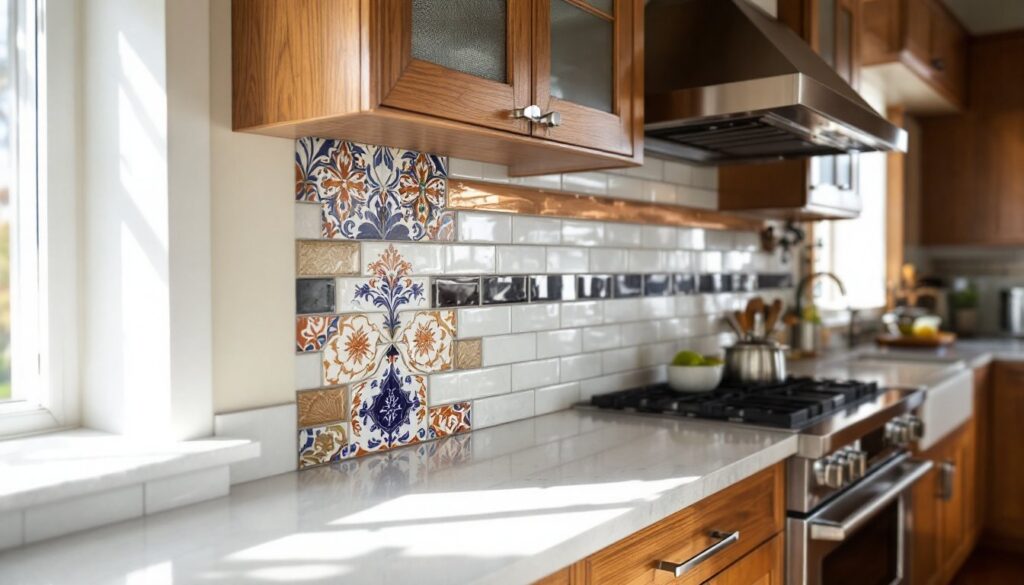
Mosaic and patterned tiles let a kitchen’s personality shine. Rather than uniform grids, these tiles mix colors, sizes, or finishes to create cohesive designs. Encaustic tiles, which feature colored clay inlaid to create patterns throughout the tile body, offer Old World charm and work beautifully in Mediterranean or Spanish Colonial kitchens. They’re more expensive ($3–$8 per square foot) and require sealing, but the payoff is undeniable character.
Hand-painted tiles offer similar artisanal appeal, often featuring floral or geometric motifs. Each piece varies slightly, adding authentic irregularity that factory-made tiles can’t replicate. Turkish, Portuguese, and Mexican hand-painted tiles are particularly striking, though pricing ($4–$10+ per square foot) reflects their labor-intensive creation.
Mosaic sheets pre-assemble small tiles (often in mosaic netting or paper-backed sheets) into repeating patterns, making installation faster and grout joint spacing consistent. Glass, ceramic, and stone can all be combined in a single mosaic. These sheets typically cost $8–$15 per square foot installed.
Geometric Patterns And Bold Designs
Geometric patterned tiles, think Moroccan zellige style, bold hex shapes, or intricate interlocking designs, make a statement without feeling overwhelming. They work best over the stovetop, on the wall behind the range, or as a full-height accent wall rather than edge-to-edge coverage. Mixed-size tiles (sometimes called patchwork or mix-and-match layouts) create visual texture by combining square, rectangular, and diamond shapes in coordinated colors.
When installing patterned tiles, the key is precision. Uneven spacing kills the pattern’s impact. Spacers are non-negotiable here. Budget extra time for layout planning, dry-lay the pattern first to confirm it works with the wall dimensions, and avoid awkward cuts at edges.
Natural Stone Backsplashes: Incorporating Marble, Granite, And Slate
Natural stone backsplashes bring authentic texture and visual depth that manufactured tiles struggle to match. Each piece is one-of-a-kind, with subtle color variations and veining.
Marble exudes luxury but demands respect. Carrara and Calacatta marble are soft, absorbent, and vulnerable to etching, acidic spills from lemon juice, vinegar, or wine leave dull marks. Honed finishes scratch more easily than polished ones. Even though the maintenance, marble’s cool elegance makes it worth considering, especially in upper-end kitchens. Cost runs $4–$12+ per square foot. Sealing is mandatory, a penetrating sealer reduces (but doesn’t eliminate) staining risk. Resealing annually is wise in a kitchen.
Granite is significantly more durable. It’s harder, denser, and more stain-resistant than marble, making it practical for active kitchens. Granite comes in rich, varied colors, black, reds, golds, blues, and earth tones, and takes a high polish or matte honed finish. Pricing: $3–$8 per square foot. Sealing is still recommended but less critical than with marble.
Slate offers a rustic, sophisticated look with subtle layering and texture. Its cleft (split) surface is uneven, wonderful for character but tricky to keep clean in a kitchen. Slate is porous and stains easily, so sealing and regular maintenance are essential. Cost: $4–$10 per square foot.
Stone tile is heavier and more brittle than ceramic, so wall prep is critical. Confirm the wall structure can support the weight (this typically isn’t an issue with standard 16-inch on-center framing, but confirm). Use a thick-set mortar (thicker than thin-set) for better support, and never leave gaps behind tiles. Stone requires a penetrating sealer after installation.
Metallic And Glass Tiles: Modern Sophistication And Light Reflection
Metallic tiles bring contemporary edge and glamour to a kitchen. These tiles feature brushed stainless steel, copper, bronze, or aluminum finishes, some solid, others as mosaics that mix metal with stone or glass. Metallic surfaces reflect light and create visual movement, making kitchens feel more dynamic and spacious.
Copper and bronze oxidize and develop patina over time, which is part of their appeal for homeowners seeking warmth and character. Stainless steel stays clean and modern. Metallic tiles work best as accents, perhaps a strip above the counter or a feature wall behind the range, rather than full coverage, as continuous reflections can feel harsh. Cost: $5–$15 per square foot.
Glass tiles are equally contemporary. Available in clear, frosted, or opaque finishes, and in various colors, glass bounces light around brilliantly. They’re non-porous, so no sealing is needed, and they’re incredibly easy to clean. The downside: glass is fragile, making it risky for areas prone to impact. Glass is also slippery underfoot if used on floor (not a backsplash concern) and can be noisy, installing glass often produces a hollow sound that some find unsettling.
Glass tiles vary in translucence: backlit installations (with LED strips behind them) amplify the luminous effect. But, this requires careful electrical work and possibly a permit. Cost: $4–$12 per square foot for basic glass, more for specialty finishes or backlit applications.
Both metallic and glass require excellent substrate preparation. Any unevenness telegraphs through and disrupts the reflective effect. Use a high-quality thin-set mortar designed for these materials, and work methodically to avoid gaps.
Handmade And Artisanal Tiles: Texture And Character For Unique Kitchens
Handmade tiles bring warmth and personality that can’t be factory-produced. These tiles are crafted individually, resulting in slight variations in color, thickness, and surface texture, the imperfections are the point. Raku tiles, fired in high-heat kilns, develop rich color variation and glossy, often-crackled surfaces. Terracotta tiles, though warm and rustic, are porous and require sealing in a kitchen environment.
Studio pottery tiles are one-offs or small-batch creations by ceramic artists, often featuring hand-painted or carved designs. These are investment pieces, $10–$50+ per tile is not uncommon, but they’re installed sparingly as accents rather than full coverage. A few artisan tiles interspersed among neutral subway tiles create a gallery-like effect.
Rammed earth or clay tiles convey organic, earthy aesthetics and feel authentic in kitchens with warm wood tones or rustic cabinetry. These materials develop patina and character over time, especially in a wet environment like a kitchen. Sealing and wax-finishing may be required depending on the specific tile.
Thickness and irregularity are hallmarks of handmade tiles. This means thicker mortar (often thick-set) is necessary to accommodate surface variations. Layout is equally important, arrange handmade tiles thoughtfully to highlight color and texture variation. Uneven grout joints are acceptable and often enhance the artisanal look, but they should still be intentional, not haphazard.
Handmade tiles demand more time and patience to install, but the result is a kitchen that feels authentic and curated, not mass-produced. For DIYers, this is where a second pair of hands, or hiring a tiler, makes sense if the budget allows.
Conclusion
Choosing a backsplash tile comes down to balancing aesthetics, durability, maintenance, and budget. Subway tile offers timeless simplicity and affordability: mosaic and patterned tiles inject personality: natural stone brings authentic texture: metallics and glass deliver modern sophistication: handmade tiles offer artistic character. The best choice aligns with the kitchen’s existing style, the homeowner’s lifestyle, and their comfort level with maintenance. Whether opting for a budget-friendly ceramic subway design or investing in artisan stone, proper substrate prep, precise layout, and quality installation make the difference between a backsplash that lasts decades and one that fails prematurely. Take time to evaluate options, plan the layout, and don’t rush the job, a thoughtful backsplash becomes the kitchen’s focal point for years to come.