Table of Contents
ToggleThe E22 error code on a Bosch dishwasher can feel like a curveball, but it’s one of the most straightforward issues to diagnose and fix yourself. This error appears when your dishwasher detects a water supply or drainage problem, nothing catastrophic, and usually nothing requiring a technician’s bill. Whether you’re dealing with a Bosch dishwasher E22 error code for the first time or troubleshooting a recurring issue, this guide walks you through what’s happening and the practical steps to get your machine running again. Most homeowners can resolve the E22 Bosch dishwasher error in under an hour with basic tools and a little patience.
Key Takeaways
- The E22 error code on a Bosch dishwasher indicates a water supply or drainage problem that most homeowners can fix within an hour using basic tools.
- Check the inlet hose for kinks, the shutoff valve for being fully open, and the inlet valve filter for mineral deposits—these are the most common causes of the E22 error.
- Clear blockages in the drain hose and empty the drain pump filter at the bottom of the tub by removing it counterclockwise and rinsing thoroughly.
- Call a professional technician if the E22 code persists after cleaning filters and hoses, as faulty inlet valves, drain motors, or control boards require specialized repair.
- Prevent future E22 errors by rinsing dishes before loading, using quality detergent, inspecting hoses annually, and cleaning the filter monthly.
What Is the E22 Error Code?
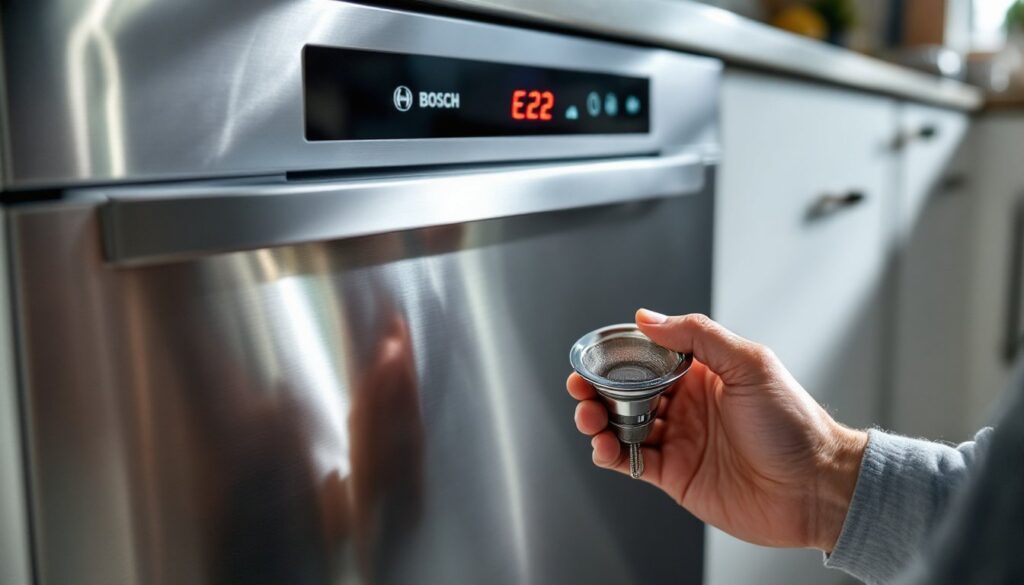
The E22 error is Bosch’s way of saying: “I can’t get water in, or I can’t push water out.” Specifically, it signals either a water inlet issue or a drain system malfunction. When the dishwasher’s sensors detect insufficient water supply or an inability to drain properly, the machine halts mid-cycle and displays the code on its control panel.
This isn’t a circuit board failure or a motor bearing problem. It’s a plumbing-related fault, which is good news, these are typically fixable without ordering replacement parts. You might see the code flash briefly during a cycle, or it might lock the door and refuse to start until you address it.
Common Causes of the E22 Error
Understanding what triggers the bosch dishwasher error code e22 helps you narrow down the fix. The culprit is almost always water-related, either coming in or going out.
Water Supply Issues
Your dishwasher needs a steady stream of water during the fill cycle. Check if the inlet valve, the mechanism that opens to let water into the tub, is stuck or partially blocked. Mineral deposits, debris, or a kinked fill hose are common offenders. If you’ve recently installed the unit or moved it, the supply line might be pinched behind cabinetry. Some homeowners also forget that the water supply shutoff valve (usually under the sink) needs to be fully open: a half-closed valve can trigger this error.
Low water pressure in your home can also cause E22 to appear. If you’ve noticed weak pressure elsewhere in your house, the dishwasher’s sensors may not be detecting adequate flow.
Drain Line Blockages
A blocked or kinked drain hose is the other prime suspect. Food particles, grease, or detergent buildup inside the hose or where it connects to your sink’s drain line can prevent water from leaving the tub. The dishwasher fills normally but can’t empty, so its sensors throw the E22 code. Check that the hose isn’t siphoning (looped too high at any point), which can trap water and fool the drain sensor.
Step-by-Step Troubleshooting Guide
Before you start, turn off power to the dishwasher at the breaker or unplug it if it has a cord. Empty the tub and lay down towels, you’ll likely spill water.
1. Check the Water Supply Line
Locate the inlet hose (usually a braided steel or rubber line under the sink). Look for kinks, cracks, or bends. Straighten any kinks gently: don’t use sharp objects. Follow the hose to the shutoff valve, turn it fully clockwise, then counterclockwise three full rotations to ensure it’s completely open. Remove the hose from both the valve and the dishwasher inlet, place a cup under the valve opening, and turn it on briefly. If water flows freely, the supply line works. If not, you may have a mineral-clogged valve that needs replacement.
2. Inspect the Inlet Valve Filter
With the hose disconnected, locate the inlet valve at the bottom of the fill hose (attached to the dishwasher itself). There’s a small mesh filter screen inside. Remove it carefully with pliers and hold it up to light. Rinse under warm water or soak it in white vinegar for 30 minutes to dissolve mineral buildup. Reinsert it and reattach the hose.
3. Check the Drain Hose
The drain hose typically connects at the sink’s P-trap or garbage disposal. Disconnect it at both ends and hold it up to a light source, you should see straight through. If it’s clogged, run hot water through it or submerge it in hot vinegar for an hour, then flush. Straighten any kinks and ensure the hose doesn’t loop above the sink rim (a siphon trap).
4. Clear the Drain Pump Filter
Inside the tub, at the bottom, you’ll find a cylindrical filter (usually removable by twisting counterclockwise). Pull it out and rinse it thoroughly under running water. Look inside the filter cavity for debris and scoop out any food particles or buildup with a small spoon or cloth.
5. Run a Test Cycle
Reassemble everything, close all connections snugly, and restore power. Run a short cycle with no dishes. If the E22 code reappears, move to the next step.
When to Call a Professional
If you’ve cleaned the inlet filter, checked the hoses for blockages, and emptied the drain pump filter, and the E22 error code persists, you’re likely facing a faulty inlet valve, drain motor, or electronic control board. These components aren’t field-serviceable without specialized training.
Also call a pro if the hoses are cracked or corroded beyond cleaning, or if your home’s water pressure is consistently low (you’ll need a pressure gauge to confirm, or ask your plumber). A licensed appliance technician can test the inlet and drain solenoids and replace them if needed. Many repairs cost $200–$400 in labor plus parts, far less than a new unit. Bosch dishwashers are generally reliable, and addressing E22 early prevents further damage.
Prevention Tips for Future Issues
Once you’ve resolved the E22 error on your E22 Bosch dishwasher, a little maintenance keeps it away.
• Use rinse aid and quality detergent. These reduce mineral and food buildup in the system.
• Rinse dishes lightly before loading. Large food particles bypass the filter and clog hoses.
• Run hot water at the sink first. Let hot water reach the dishwasher supply line before starting a cycle.
• Inspect hoses annually. Look for splits, bulges, or discoloration every 6–12 months, especially if your water is hard.
• Clean the filter monthly. A quick rinse during regular cleaning prevents slow drainage.
• Check water pressure occasionally. If new appliances or a renovation changed your plumbing, verify pressure is between 40–80 psi.
These small habits add years to your dishwasher’s life and spare you future error codes and service calls.